Something I dealt with recently in independent exchanges with several different people was about programming with IBM MQ, and dealing with MQI errors that might not be errors. This post is a short discussion about the not-quite-failed status of a warning. Is it an error? What is the difference between MQI errors and warnings?
A recent thread on mqseries.net asked about controlling queue creation in MQ. In particular, how to set authorities so that one user can create queues like “ABC…” but not “DEF…”. There are answers given in that thread both on the ability to do it, and the reason why it’s not usually something that’s needed.
In summary, it’s not possible to control it with setmqaut commands. And since queue creation is usually done by administrators, there’s not really any need to restrict it further.
But the thread did remind me of some code I’d written a few years ago while considering the same question as part of a larger piece of work. And so I thought I’d dredge up that PoC and make it a bit more readable. It shows how you can, in fact, implement that level of control on platforms where you can install extensions to the MQ Authorisation interface.
One of the common mistakes that people make when they first start programming with the MQI can be seen in this pseudo-code example:
MQMD md = {MQMD_DEFAULT}
MQGMO gmo = {MQGMO_DEFAULT}
int bufsize = 128
PMQCHAR buf = malloc(bufsize)
do {
  MQGET(&md,&gmo,buf,bufsize))
} while (rc != MQRC_NO_MSG_AVAILABLE)
They complain that despite pre-loading the queue, only a single message is returned. Anyone reading this is likely to recognise immediately the problem: the MsgId of the first message is returned in the md variable. The next iteration of the loop tries to match that MsgID and doesn’t find any more messages.
There are aspects of the MQI that try to minimise your chances of getting this wrong, like the MatchOptions flag in the MQGMO structure. But that in turn requires you know a) to set it and b) override the default version of the structure.
Having worked with MQ for so many years, I am hopefully not going to make that kind of mistake. But I still got caught out recently by a very similar problem.
The mq-metric-samples collectors that send IBM MQ metrics and status data to a range of databases, ready to be viewed in Grafana, have just been enhanced to collect additional information. The Prometheus collector has also been extended so that it can continue providing limited status even when the queue manager is down.
The new metrics have all been suggested by users of the package either directly or via issues raised in the GitHub repository. Many previous articles on here show more about the collectors.
The InfluxDB collector is also refreshed for a new version of the database.
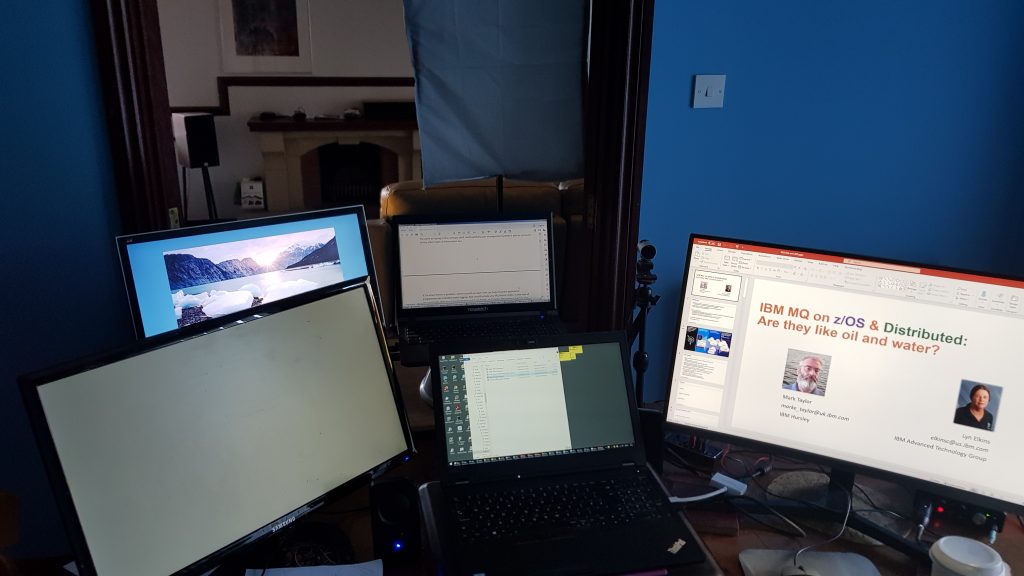
Doing a web seminar session yesterday I knew I wanted a second machine available. Partly as an HA failover backup (just in case), and partly to act as a view of what the other participants were seeing – which I can’t see on the system I’m driving a presentation from. Though as I cabled everything together, it did start to look a little silly. Or like a set from a bad TV show.
Five screens, one desk
But I did actually find a use for just about all of the panels.
The secondary system had the live seminar contents, along with the text-based chat screen so I could see when people raised questions. And I had some written notes associated with the presentations that I could scroll through as the event progressed.
The primary system had one panel with the full-screen presentation, another panel with a preview of the next slide, and a further panel with all my other activities including a chat window where I could type private notes to my co-presenter if necessary.
Could I have managed with fewer screens? Probably, but having all that space did make it easy to manage and have the windows and fonts expanded large enough so I didn’t have to peer hard at small text.
I’ve now moved the 2nd laptop next to the big TV so I can use it to show the county championship cricket games available only via live streaming services. But it can brought back to the desk if needed for another web conference.
This post was last updated on April 30th, 2021 at 02:41 pm
If you’ve done any work with the Spring frameworks for Java programs, then you will know that one of the good things about Spring is that it hides a lot of the underlying operations from you. But equally, one of the bad things about Spring is that it hides a lot of the underlying operations from you. I noticed that I was getting several questions about what was happening under the covers from people using the MQ Spring Boot starter. This post shows how you can see what Spring is doing to a queue manager.
It is odd how often similar questions come at the same time from unrelated places. Because of the projects and articles I’ve written about visualising MQ’s metrics in Grafana, I recently had a couple of people asking about using that same front-end but able to work with log-file data. Specifically would it be possible to use Loki and Grafana together with MQ. My immediate reaction was that I didn’t know what Loki was in this context, but clearly they couldn’t be asking about a Norse god or Marvel character. Instead after a very short search and a few minutes reading, I guessed that it ought to be possible to use it. Which was my reply.
But of course, I’m not likely to leave it there when I learn about a new tool. Especially when I have a reasonable starting point like a working local Grafana setup. And so I have done some very quick experiments to prove that the approach really can work. On the way I’ll also take a brief digression into using logrotate.
A requirement I’ve seen a couple of times recently asked how to save an MQ queue manager’s configuration in a different format than MQSC. This short post shows one way to do that.
One tool I created a few years ago deals with formatting SMF records from z/OS. I designed it to take MQ’s 115 and 116 records and generate output that users could import to spreadsheets and SQL databases. I made a video about the original version of the tool here, and I wrote about more enhancements to that tool in this post.
If you want to know more about how to use the data after formatting, then Lyn had a lot of posts at her site talking about analyses she has run and lessons she has learned. (That site is currently offline, but a lot of the posts have been recovered by Morag and posted here.)
Most recently I’ve added (with help) some formatting options to deal with a couple of additional record types. That work showed how non-standardised SMF records are, and how much manual work is needed to create formatters. This post will talk about how something that supposedly has a common format does not really.